
Written by Isabella Rix
On March 8th, each year, we come together for International Women’s Day. We take time to reflect on the achievements of women, society’s progress toward women’s liberation and to consider how we can continue to shape our world for an equitable future for women and girls. Mulika Afrika is a non-profit organisation based in Tanzania that focuses on improving the well-being of Maasai communities, who are native to Northern, Central and Southern Kenya and Northern Tanzania. Mulika Afrika develops comprehensive, community led programmes that address health, educationeconomic empowerment and environmental sustainability, integrating local indigenous knowledge to foster sustainable development.
Mulika Afrika embodies the spirit of International Women’s Day, putting its ideals front and centre and into action. We understand that women’s empowerment does not come from a single programme, but from continuous wide-ranging commitment to girls’ education, economic empowerment and bodily knowledge. Our aim is to support women and girls in the Maasai community whilst upholding and honouring their cultural traditions and knowledge.
Women in Maasai Communities
At Mulika Afrika we are deeply committed to supporting women and girls throughout their lives. For many, access to education remains a significant challenge. This can be down to simple factors such as proximity to schools, and economic hardship, or more complex issues such as the requirement to fulfil marriage commitments often due to social pressures or economic necessity. Without a doubt, education and opportunities for economic freedom are essential for all. This is why The Naboishu Maasai Community School is dedicated to providing education to rural Maasai communities. The school began thanks to two mothers. In the beginning, these women taught a small group of children from under the shade of a tree. From here, The Naboishu Maasai Community School has grown into two classrooms, an office and a toilet block with space for 52 children.
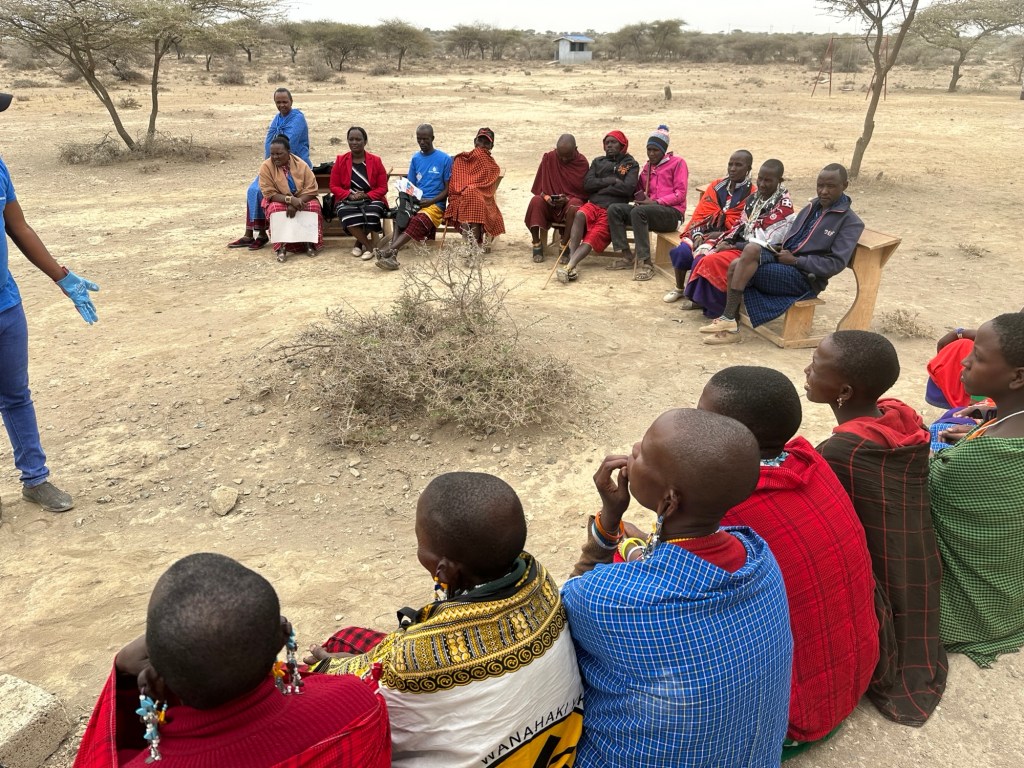
We have many examples of how women empower women in the Maasai communities because, truly, change is more effective and long-lasting when it comes from within the community. That’s why we are supporting local health workers to teach their communities about their bodies and reproductive rights. Through our Rain Workers programme we are making knowledge rain and are on track to reaching approximately 45,000 people in rural Maasai regions. Our advocacy practice is guided by understanding, not confrontation. Through respectful community dialogue we also engage men and boys in the conversation, making families and communities stronger against harmful and gendered practices such as FGM, sexual health issues such as HIV/AIDS and supporting women’s knowledge and agency in Family Planning.
This work goes hand in hand with supporting the economic freedom of women, so that they can create and pursue their own futures. At Mulika Afrika we believe everyone can meaningfully contribute to their community, so we support those who were formerly involved with FGM practices and people with disabilities to take on alternative training and skill development to create fresh avenues of income through our Economic Empowerment Programmes. Already, a group of women who were formerly involved with harmful FGM practices have formed a cooperative to practice tailoring, beading and other in-demand craft work, to contribute to the economic fabric of their community.
The Future for Maasai Women and Mulika Afrika
Whilst it’s important to recognise the impact our work with Maasai communities has already done, our work does not and cannot stop here. Women and girls continue to face complex obstacles to free and equitable lives, for example, The Naboishu Community School requires a sustainable water source, our health education programmes need follow-up and continued training and our Economic Empowerment Programmes need refinement and expansion. But, with the right funding and considered approach, Mulika Afrika will continue to contribute toward a prosperous future for all Maasai communities, whilst respecting and upholding their integral traditions and culture. With your support we can expand these opportunities even further. With that, we invite you to stand with Maasai women beyond this one day, and to get involved with Mulika Afrika.
When women and girls are educated, communities prosper – sponsor or donate to support the Naboishu Maasai Community School. Women’s health goes hand in hand with thriving communities – contribute to our ‘Rain Workers’ programme to support health education. When women lead, societies transform – donate and help us expand our Economic Empowerment Programme. And because change happens from within – support our sustainable agriculture and livestock practices.
Together, we can contribute to the freedom, prosperity and health of all women and girls.

